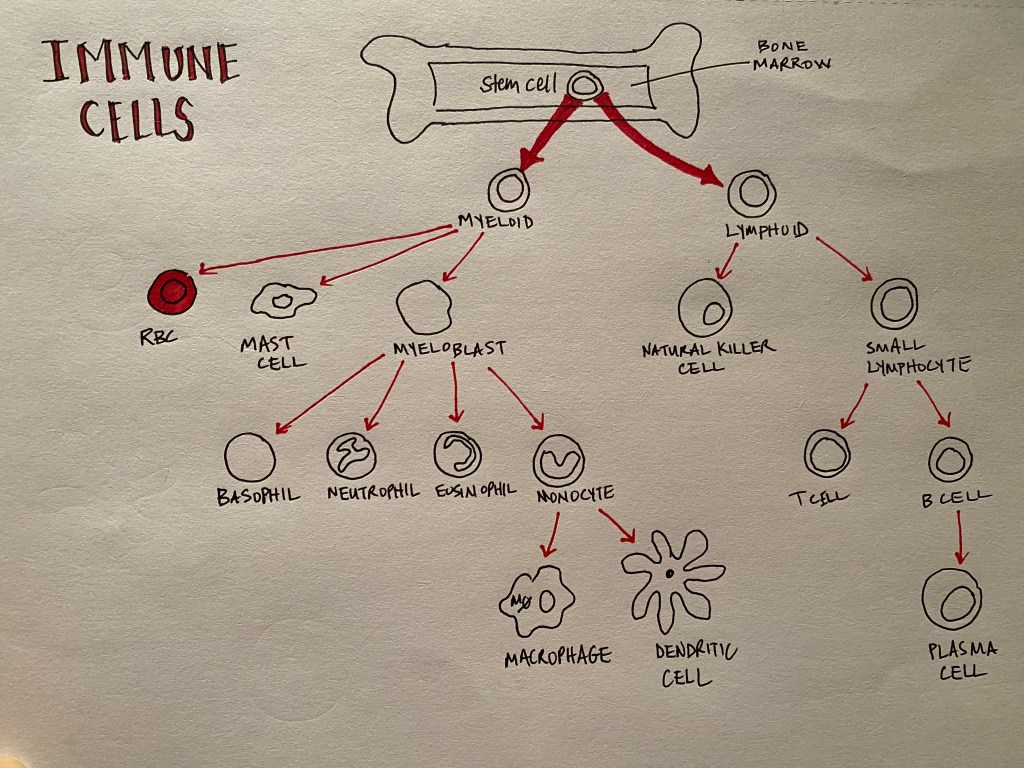
Recall from last week that our immune system has two main divisions – the innate and the adaptive. The innate immune system is our first line of defence against pathogens. It includes physical barriers, chemical signals and cellular actions. The skin and mucosal membranes of the respiratory, digestive and urogenital systems form the first line of defense against pathogens (bacteria, viruses and parasites). The integrity of our skin and mucous membranes is very important. If our skin or mucosal membranes are irritated or injured, it is easier for pathogens to breach this physical barrier. When a pathogen breaches this first line of defence, a series of chemical and cellular events unfold immediately to attack and kill the pathogen. The cells that constitute the innate immune system are born from stem cells in the bone marrow, which is part of the lymphatic system. Through a number of steps the pleuripotent stem cells of the bone marrow give rise to white blood cells or leukocytes (neutrophils, eosinophils, basophils, macrophages and lymphocytes), red blood cells (erythrocytes), platelets, mast cells, and dendritic cells. I know that is a mouthful, but leaving any of them out would be like leaving the transmission out of a discussion about vehicles.
Have a look at the diagram below. The stem cells in the bone marrow give birth to two lineages. The left side, or the myeloid lineage, forms the cells of the innate immune system. The right side, the lymphoid lineage, forms the cells of the adaptive system (next weeks topic).
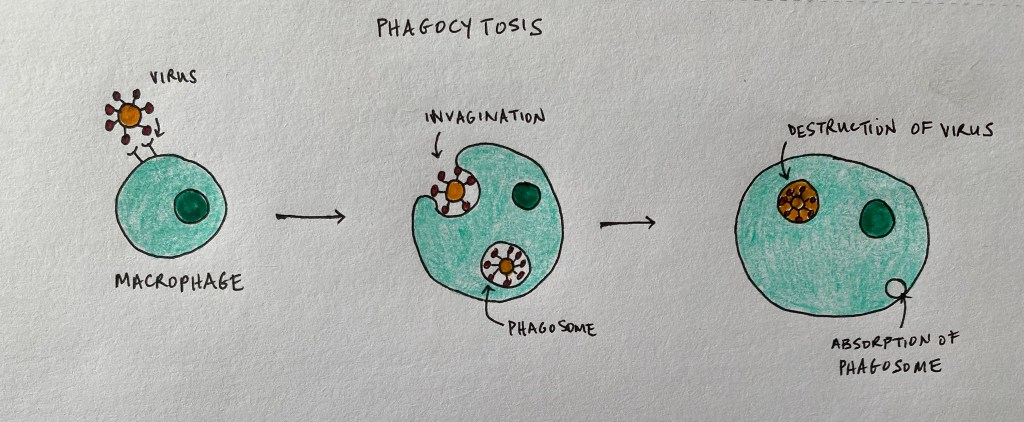
Macrophages and mast cells dwell in the tissue, and are at the ready when a pathogen enters. The presence of a pathogen triggers a cascade of messages and actions that occur in concert, with the aim of destroying and removing the pathogen. This immediate response spans the first several hours to day after exposure. Messages relayed by histamine (released by mast cells) encourages dilation of the blood vessels so that cells, proteins and molecules can move more freely through the walls, and into the tissues where needed. Neutrophils (the most abundant white blood cell) circulates in the blood until it is called to a site of infection/injury to engulf and eat the pathogen or infected cell in a process known as phagocytosis. Macrophages also target and kill pathogens/infected cells via phagocytosis.
Complement proteins, secreted by the liver, circulate in the blood until needed in a particular tissue. They surround the pathogen making it easier for macrophages and neutrophils to attack and destroy, and also enhance inflammation via cytokines. Cytokines are molecules that mediate and regulate the inflammatory and immune response. Over the past year, you have likely heard about a ‘cytokine storm’ in relation to Covid. This is when a healthy and helpful inflammatory process is not appropriately regulated and overwhelms the body causing a severe and potentially deadly situation. That said, inflammation is a necessary and important process in a healthy response to a pathogen or injury.
If the infection warrants further support, the dendritic cells are the messenger to alert the adaptive system to bring further reinforcements in the form of a pathogen specific response known as antibodies. We will dive deeper on the adaptive system next week.

Vitamins & Minerals that Support Immune Health
Vitamin D: we discussed this last week. Ensuring you have sufficient vitamin D levels is an important part of supporting good immune health.
Vitamin A: an essential vitamin that we must consume in our diet (we cannot make it). It supports the health of the barrier tissues (skin & mucous membranes). Too much is toxic, so supplement with care.
Food sources: salmon, shrimp, eggs, sweet potatoes, carrots, spinach, kale, swish chard, winter squash
Zinc: an essential mineral that must be consumed in our diet regularly, as we cannot store it for a rainy day. Zinc supports brain function, and boosts immune function by supporting the development and action of neutrophils and macrophages.
Food sources: oysters, beef, chicken, pumpkin seeds, cashews, chickpeas
Vitamin C: it increases antioxidant activity, and supports the absorption of nutrients. It helps to stimulate the production of leukocytes (wbc’s), supports neutrophils and increases the levels of circulating complement proteins. The antioxidant function is important as our immune cells release chemical defences to damage and kill targeted cells – vitamin c helps to protect our body’s cells against these actions.
Food sources: citrus, bell peppers, strawberries, cantaloupe, brussel sprouts, broccoli, tomatoes
 juliebrown.health